
One of the main reasons is that it becomes increasingly difficult to understand what is actually driving business performance.
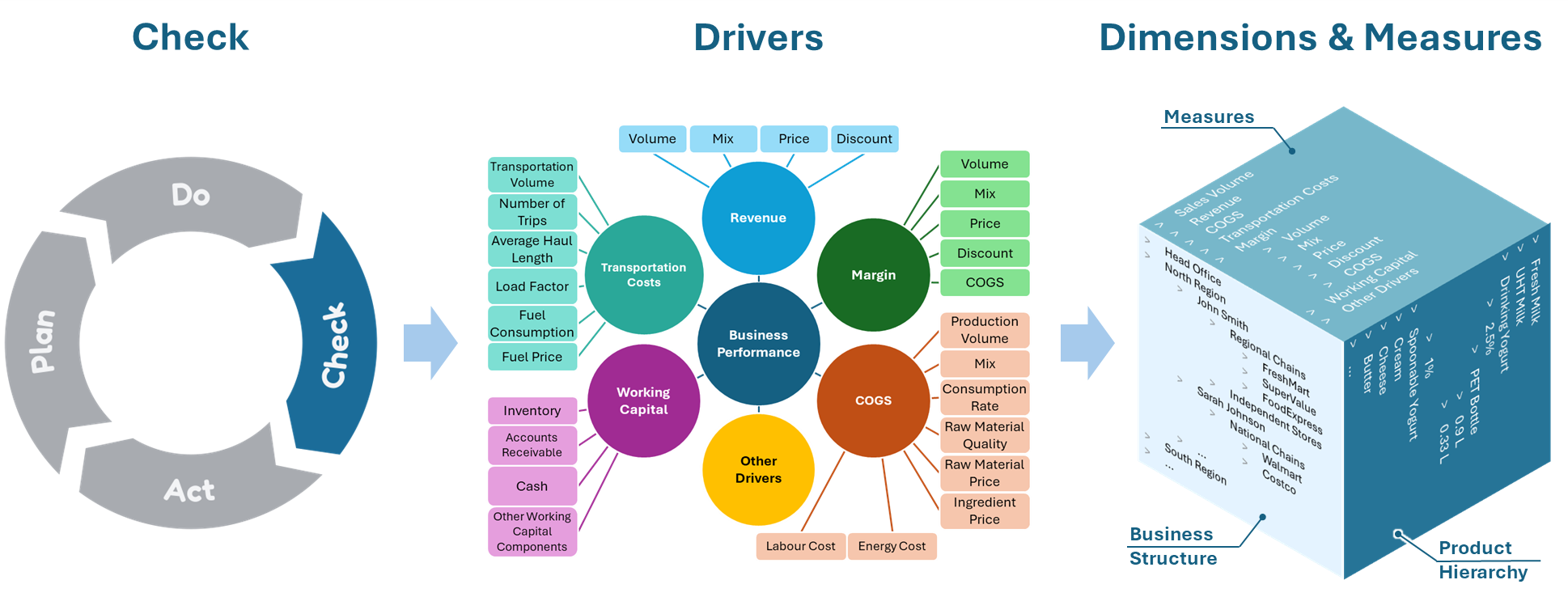
Managing any company follows the same cycle: Plan → Do → Check → Act. Corrective actions only make sense when the causes of deviations are clearly understood. Identifying those causes is the purpose of the Check stage.
This requires analysing business performance drivers. High-level results are broken down into their underlying components. For example, Revenue can be decomposed into Volume, Mix, Price, and Discount, while COGS can be analysed through Consumption Rate, Raw Material Price, Raw Material Quality, and other operational drivers.
The next step is to measure the impact of each driver on the overall result. This allows managers to determine exactly which changes, events, or decisions caused a variance and how much each contributed. The specific set of drivers and the level of analytical detail differ from one company to another, depending on its business processes and reporting structure.
In a simple business with a single product and a single sales channel, the analysis may stop there. In a more complex organisation, however, every driver must be analysed separately for each product and across the entire business structure, including regions, branches, sales channels, retail chains, managers, production sites, and other organisational elements.
As a result, analysis expands into three dimensions:
- Drivers
- Product Hierarchy
- Business Structure
The number of possible combinations quickly becomes enormous. Analysing all of them manually is practically impossible. Consequently, during the Check stage, organisations typically focus on only a fraction of the available dimensions, while many important insights remain hidden.
Without comprehensive analysis, corrective actions are based only on overall business performance. The total variance may appear insignificant even though some products, regions, or channels are underperforming while others are compensating for these losses.
When the overall result is positive, management may assume everything is on track. In reality, negative trends may already be developing beneath the surface, temporarily masked by strong performance elsewhere. When the overall result is negative, it becomes difficult to identify the exact root cause, responsible business unit, decision-maker, or business decision that led to the deviation.
As a result, incomplete analysis leads to incorrect corrective actions. Those actions then influence the next planning cycle. The management process continues to move forward, but every new cycle starts with unresolved issues carried over from the previous one.
This is one of the key reasons why complex businesses are harder to manage.
Fincontrollex Variance Analysis breaks down variances across all three dimensions simultaneously: Drivers, Product Hierarchy, and Business Structure. This enables organisations to identify root causes quickly and accurately.
The solution also allows companies to benchmark regions, channels, products, branches, managers, or any other element of their business structure against one another. Such comparisons help uncover hidden opportunities by revealing what top performers do differently and which successful practices can be replicated across the organisation.
More details about Fincontrollex Variance Analysis: https://www.fincontrollex.com/go/neo1bA5