
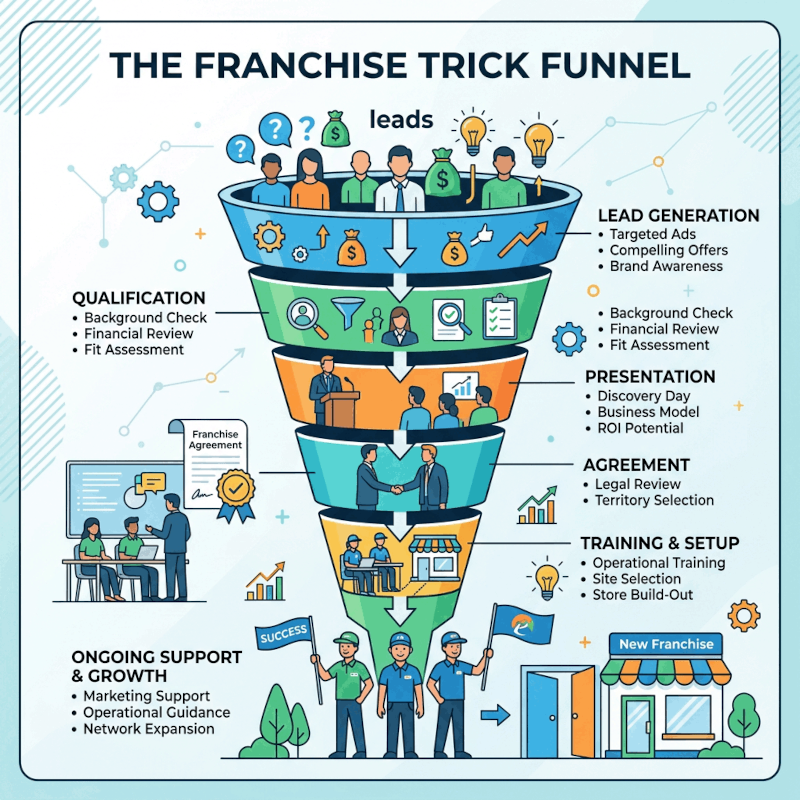
Buying a franchise is often sold as a shortcut to business ownership. Sometimes it is. But if an entrepreneur is choosing across different concepts, and even different industries, the path to a first meaningful financial view can stretch into weeks or even months. In that time, it is easy to collect marketing promises, sit through introductory calls, fill out applications, disclose sensitive personal financial information, go through a credit check, and still not answer the most basic question: Is this franchise likely to make money? And does it deserve any more of your time?
That is one of the franchise market’s biggest inefficiencies. Yes, you can attend an expo and see dozens of brands in a day. But that is usually the start of a sales process, not the start of financial clarity. At the booth, you hear about brand strength, support, growth, culture, and success stories. You get invited to continue the conversation one-on-one. Sometimes you even hear that franchising is “like getting married.” Maybe. But none of that gets you closer to the economics of the deal.
There’s another point that first-time buyers often underestimate. Many intermediaries in this market call themselves advisors, coaches, or consultants. In practice, many franchise brokers work for franchisors and are paid when a deal closes. That creates a structural tilt from day one. The buyer is surrounded by people whose job is to move the process forward. There are far fewer tools designed to help that same buyer run a fast, independent financial screen before giving an opportunity more time.
Meanwhile, the market itself is enormous. The International Franchise Association projects about 851,000 franchise establishments in the United States in 2025, more than 9 million jobs, and $936.4 billion in total franchise output, with personal services among the fastest-growing segments. In a market that large, comparing opportunities by story, presentation quality, or how polished the deck looks is a poor way to allocate capital. If you are comparing multiple projects across different sectors, months disappear almost by default unless you apply an early financial screen.
Why Waiting for the FDD Is Often Too Late
Long before the FDD arrives, an entrepreneur wants to know: Is this even worth pursuing?
The FDD is the core disclosure document. A prospective franchisee must receive the Franchise Disclosure Document at least 14 days before signing an agreement or paying money to the franchisor or an affiliate. The FTC (Federal Trade Commission) also says you have the right to ask for, and get, a copy once the franchisor has received your application and agreed to consider it. That is an important protection. But for an owner-operator or investor, there is still a practical mismatch: you usually want to know whether the economics look compelling enough to justify going further well before the document shows up.
That mismatch matters even more because Item 19, the section of the FDD that deals with financial performance representations, is optional in one important respect. The FTC is explicit: the Franchise Rule does not require a franchisor to provide sales or earnings information. But if claims about sales, income, or profits are made, they must appear in Item 19. That is not a technical detail. It is a serious filter. If the sales pitch leans on profitability but the FDD does not back it up, that is not harmless marketing. It is a warning sign.
The FTC also warns that franchise expos and follow-up promotional meetings can expose prospective buyers to high-pressure sales tactics. That helps explain why so many early conversations stay heavy on narrative and light on numbers.
What Numbers Are Enough for a First Go/No-Go Decision
A full franchise assessment model needs more than three inputs. You eventually want to understand the ad fund, local marketing spend, rent, payroll structure, ramp-up, financing, taxes, owner replacement cost, maintenance capex, renewal capex, working capital, and lease terms. But for the continue-or-walk-away decision, the dataset can be much smaller.
Minimum for a first-pass screen | Why it matters |
| 1. Total investment | The full cost of entry: franchise fee, buildout, equipment, pre-opening costs, and the opening cash buffer. |
| 2. Annual revenue | Not necessarily one “perfect” number. A range, median, or average is enough to build working scenarios. |
| 3. Operating profit/margin | The most important filter. It tells you how much economics remain after core operating costs and whether the unit has a realistic chance of working. |
In other words, the first filter does not require a 20-tab workbook. It requires a basic structure that can tell you whether the concept creates any reasonable return at all.
This is also why ranges are not a problem. They are an advantage. A franchisor will often say that revenue depends on the state, trade area, operator, and local execution. That is fair. It is also exactly why sensitivity analysis matters. When you get a range on investment or sales, do not stop. Build scenarios. Run a base case, an upside case, and a downside case. Look at a revenue-margin heat map. Calculate break-even. Test how much slippage the model can absorb before it stops working.
Why External Benchmarks Matter
One of the most common mistakes future franchisees make is taking a stated margin at face value without checking the industry. Even if the brand sounds compelling, any promised profitability still needs a sanity check against the outside world.
Public U.S. market data compiled by NYU Stern put the Restaurant/Dining category at about 15.79% pre-tax unadjusted operating margin and 13.79% pre-tax lease-adjusted margin. Those are not unit-level franchise margins, and they are not a direct standard for a small private operator. But they are still useful as an external reference point. If a concept promises profitability materially above the benchmark, the next reaction should not be “great.” It should be “what exactly is driving that gap, and which costs may be understated or omitted?”
The review usually comes back to the same list: occupancy costs, labor pressure, manager replacement, local marketing, software, repairs and maintenance, insurance, royalties, ad fund, and the expenses that get brushed aside as “operator efficiency.” This is where the gap between a clean marketing story and a sustainable operating reality usually starts to show.
Illustrative Example: Anytime Fitness
This is not investment advice, and it is not an official earnings claim from the brand. It is simply an illustration of what a quick feasibility screen looks like. For this example, we use a rough investment level of about $680K to $685K including the franchise fee, an estimated average annual revenue of about $443K from historical public reporting, and an operating margin assumption of 16.5%. That is already enough to answer the first serious question: does the concept appear to have enough cushion, and is it worth deeper due diligence?
Table 1. Sample feasibility screen results for Anytime Fitness
Metric | Value | How to read it |
| NPV | $874,376 | A strong positive NPV suggests that, under these assumptions, the project creates economic value instead of merely returning capital. |
| IRR | 33.51% | This looks strong, but IRR is one of the most sensitive metrics in the model. It can move quickly if revenue or margin weakens. |
| Payback | 3.03 yr | The simple payback period suggests the initial investment is recovered in roughly three years before accounting for the time value of money. |
| Break-even | $237,337 | A key stability line. The number matters less by itself than in relation to expected sales. |
| Margin of Safety | 43.76% | One of the most useful early-screen indicators. Revenue could fall meaningfully before the project approaches break-even. |
The point of this example is not that Anytime Fitness is automatically a good buy. The point is that even with a limited set of inputs, you can get to a first meaningful decision very quickly. Under these assumptions, the concept looks not only profitable but reasonably resilient as well. That is enough to justify going deeper.
That is what early screening is for. It does not replace due diligence. It saves time before you get there. Legal review, FDD review, conversations with current and former franchisees, lease assumptions, local demand, staffing model, and site economics still matter. They matter a lot. But they belong after the base economics pass a minimum sanity check, not before it.
Screen First, Diligence Second
If you want to save time and avoid the standard franchise trap, do not start with secondary material. Marketing brochures, success stories, charismatic brand representatives, polished presentations, all of that may deserve attention. Just not at the beginning.
What you need first is a fast screen: three core numbers, a few scenarios, outside benchmarks, break-even, and margin of safety. If the model fails that test even in the base case, that is your answer. If it clears it, then you have a reason to keep going. Some franchise systems disclose enough for that first-pass analysis to be done surprisingly fast.
Tools like Fincontrollex Instant Investment Analysis are built for exactly this purpose: to shorten the path to a first useful answer and help entrepreneurs decide whether a specific franchisor deserves the next few weeks of their life, or whether their attention is better spent elsewhere.
Learn more about Fincontrollex Instant Investment Analysis.
Selected Sources
• FTC, A Consumer’s Guide to Buying a Franchise, https://www.ftc.gov/business-guidance/resources/consumers-guide-buying-franchise
• FTC, Franchise Fundamentals: Researching franchise opportunities, https://www.ftc.gov/business-guidance/blog/2023/05/franchise-fundamentals-researching-franchise-opportunities
• FTC, Franchise Fundamentals: Taking a deep dive into the Franchise Disclosure Document, https://www.ftc.gov/business-guidance/blog/2023/05/franchise-fundamentals-taking-deep-dive-franchise-disclosure-document
• International Franchise Association, 2025 economic outlook, https://www.franchise.org/2025/02/for-second-consecutive-year-franchising-exceeds-economic-expectations-outpaces-broader-economy/
• NYU Stern / Aswath Damodaran, Operating and Net Margins by Industry, https://pages.stern.nyu.edu/~adamodar/New_Home_Page/datafile/margin.html
• Anytime Fitness, What It Takes to Be an Anytime Fitness Franchisee, https://www.anytimefitness.com/franchise/what-it-takes-to-be-an-anytime-fitness-franchisee